

Attention is a belief system!
Setting the Context:
Scenario 1:
It was a quiet Saturday afternoon. I sat in my car waiting for the mechanic to fix a recurring issue, my phone left upstairs. With nothing to scroll, I played one of my favourite Sherlocks game - sketching passersby.
A bald man in his fifties pausing every few steps to squint at his phone; a woman balancing groceries awkwardly to keep one hand free and check her phone.
Suddenly, a van thundered past. The man froze, eyes darting to the noise, while the woman, still scrolling, stepped onto the footpath - both, lost in their screens, instinctively reacting to the same sound.
Hold on to this thought while we quickly look at scenario 2.
Scenario 2:
Let’s try a quick experiment by playing the video below.

If you noticed the hidden detail, kudos to you; if not, you’re in good company.
Notice the contrast:
In Scenario 1, people still sensed changes outside their immediate sphere of engagement
In Scenario 2, even within one setting, detection wasn’t guaranteed
So, what exactly is attention? Researchers at Microsoft define attention as the emotional, cognitive, and behavioural connection that forms between a user and a resource [1]. In simpler terms, attention isn’t just what slips into the spotlight-
“It’s what the mind finds worthy to create cognitive stickiness.”
Additionally, when we focus deeply, the brain selectively tunes in and all other signals fade. This leads us to another truth -
“Attention, however divided, is carefully conserved”
This explains why we often miss what’s right in front of us while watching an entire scene, like that Starbucks cup slipping in a Game of Thrones episode.

In digital products, attention reveals what truly matters to users. As Richard Thaler explains, our attention is limited, so we naturally focus on what feels easy or rewarding. But how do we measure focus in a digital context? Let’s find out.
ESTIMATING THE INTANGIBLE, TANGIBLY:
Click on the carousel to know more about them and their citations.

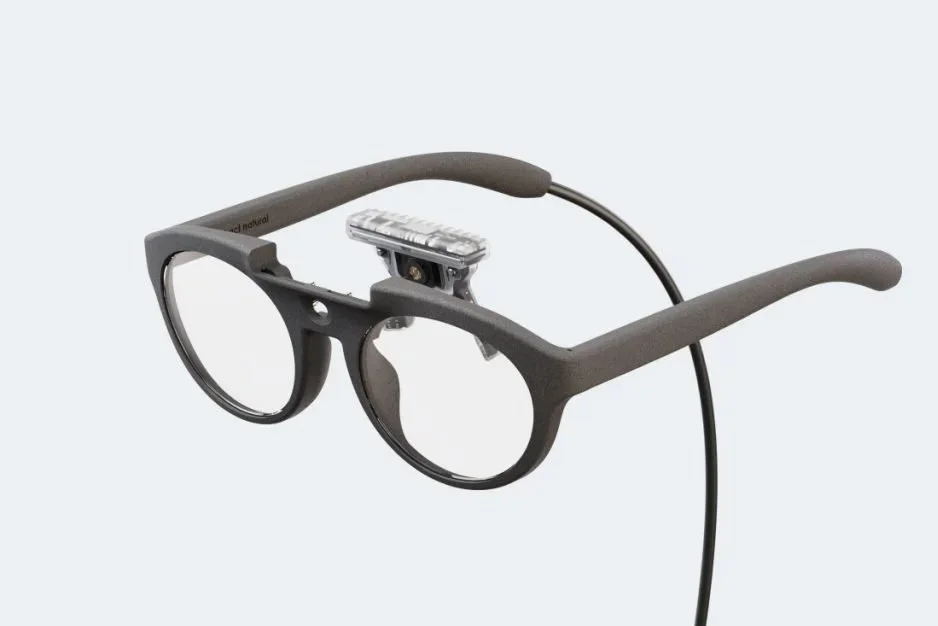

IMPORTANT TAKEAWAYS FROM RESEARCH:
Now that we have established how to diagnose attention, let’s dive deeper into what research reveals about user attention.
See, stare, move on:
The first few seconds often decide whether users will continue or move on. On Facebook, users judge content within 1-3 seconds [7], news readers usually within 10 seconds [5]. If nothing hooks them, they move on.
Saliency wins the eye, not the mind:
Motion or salient visuals are often used as attention hooks to arrest early dropoffs.
Salient cues draw attention to key highlights almost instantly due to their design and placement. For instance, in the news article research [5], articles starting with an image held readers twice as long at the top. Yet, that pause didn’t increase the share of readers who finished the article. True engagement still depends on quality and relevance.
Secondly, while such cues enhance quick detection, they can limit engagement with non-highlighted areas. In one experiment [8], users were asked to monitor functionality of drones deployed across a larger demographic. Visual signals helped observers detect critical events amid peripheral ones. However, this localised focus reduced attention with surrounding areas, slowing users’ grasp of situational awareness.
It’s fair to say that salient design commands attention and can be a powerful tool, but it doesn’t channel attention to a fulfilling engagement. Unless of course you design for it.
Assuming the hook works, the next challenge is then sustaining attention.
Specificity breeds efficiency; ambiguity breeds depth
When deciding whether to stay with a piece of content, user attention isn’t linear. People jump from the start to the middle, skip to the end, scroll back again [5]. These patterns depend largely on what they’re looking for and how clearly they know it.
Think of it like using a search engine that segments queries as shown below [9]:
What they seek:
Factual - finding a specific answer.
Intellectual - understanding a topic more deeply.
How clear their goal is:
Specific - well-defined, focused.
Evolving - vague at first, clearer as they explore.
Note: Users browsing in a hurry are excluded from this observation.
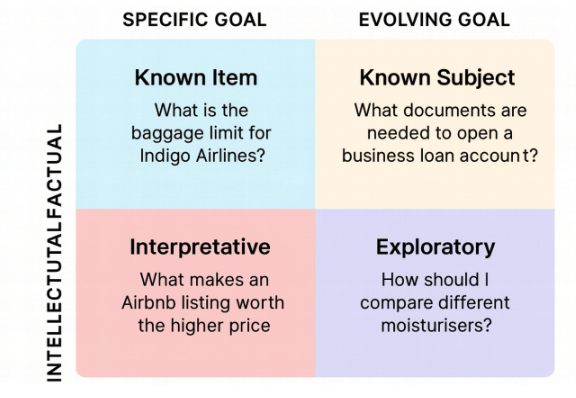
When user goals are specific, users tend to move with precision. This means longer search scans, fewer clicks and shorter dwell times. Because they’re looking for confirmation, not exploration, their attention quickly shifts if there is no direct value from the page, with fewer users scrolling deeper.
When user goals are evolving and/or intellectual, users spend longer on clicked pages, browsing deeper for validation. Viewport time on a clicked page is no longer decaying, but it peaks twice- early and later, as users scroll through the same document. This is where we see deeper engagement. In case of videos, this is showcased by video completion rates [10].
| Aspect | Known Item | Known Subject | Interpretative | Exploratory |
|---|---|---|---|---|
| Search (# queries) | High | Moderate | Low | High |
| # Clicks | Low | Moderate | Moderate | High |
| Unique # fixations on links | High | Moderate | Low to Moderate | Very High |
| % Time on search page | Moderate to High | Moderate | Moderate | High |
| % Time reading clicked pages | Moderate | High | High | Moderate |
| Depth of search | Low | Moderate | Moderate to High | Very High |
| Table 1: User search activeness with respect to their goals | ||||
Translating this into design means shaping experiences that adapt as per intent and stage of exploration. Higher ambiguity -> higher effort and cognitive load. Higher specificity -> less clutter.
This calls for context driven design:
Known subject, Interpretative and Exploratory goals:
For these users, product design should prioritize context continuity and progressive structures, allowing them to move naturally from overview to insight without friction
Thought experiments:
Show progress bars/completion rings to users - you started here and have now reached here in last 5 sessions. These are users seeking goal completion and the right visibility of progress can nudge them forward
Allowing users to freeze product options using a checkbox and refresh others in a product listing page while they compare, evaluate and make informed decisions. Slide in a comparison pane: rows show “Key feature”, “Price”, “Delivery time”, “User rating”, etc
Known-item users:
LLMs can improve click precision by visually reasoning why specific results align with a user’s query
Thought experiments:
If known-item: show clean, minimal snippet: image + key attribute + “matched because you searched for <feature>”
These few thought experiments can then be validated through A/B tests or causal inference models to measure how design interventions truly shape attention and exploration depth.
The Flatline of Focus:
But even as design refines how users explore and engage, there’s an upper bound to how long attention can stretch. Even the best-designed feeds hit a ceiling. On TikTok Shorts (<60s), user attention stabilizes around 45% [10].
In other words, in a platform that harbors hours of daily engagement [11], barely half the videos reach completion. Infinite scroll doesn’t mean infinite focus.
Remember, attention is always meant to stabilize.
CONCLUSION:
There is a popular opinion today that attention is an economy that’s becoming exponentially costlier to earn; rivaling traditional acquisition costs. And while the trade is an intricate one, the heart of attention lies in seeking a meaningful connection, one that remains the primary driver of intent and fulfilling engagement.
In this piece, I set out to introduce what attention truly is. We explored how users approach a task, how their focus evolves across that journey, and what truly tugs at their mental spotlight. Along the way, we discovered that effort and friction are two powerful levers that can either anchor or repel your user.
How exactly we can make user journeys smoother is a story for another day. I’ll pick it up in my next one.
Until then, Anbudan!
REFERENCES:
| # | Papers & Authors |
|---|---|
| 1 |
Towards a Science of User Engagement
S Attfield, G Kazai, M Lalmas, B Piwowarski (Cited by 438)


|
| 2 | User Engagement in Online News: Sentiment, Interest, Affect, and Gaze |
| 3 |
What Are You Looking For? An Eye-tracking Study of Information Usage in Web Search
Edward Cutrell, Zhiwei Guan (Cited by 723)
|
| 4 |
Eyetracking in Online Search
Laura Granka, Matthew Feusner, Lori Lorigo

|
| 5 |
Understanding and Measuring User Engagement and Attention in Online News Reading
D Lagun, M Lalmas (Cited by 35)

|
| 6 | Learning Efficient Representations of Mouse Movements to Predict User Attention |
| 7 | https://www.facebook.com/business/news/updated-features-for-video-ads |
| 8 | Understanding and Predicting Temporal Visual Attention Influenced by Dynamic Highlights in Monitoring Task |
| 9 |
Searching, Browsing, and Clicking in a Search Session: Changes in User Behavior by Task and Over Time
Jiepu Jiang, Daqing He, James Allan (Cited by 170)

|
| 10 |
Analyzing User Engagement with TikTok's Short Format Video Recommendations Using Data Donations
S Zannettou, O Nemes-Nemeth (Cited by 55)

|
| 11 | Instagram & YouTube Stats |
Other suggested reads:
DV365: Extremely Long User History Modeling at Instagram, W Lyu, D Tyagi, Y Yang, Z Li (Cited by 1)
Viewing time as a cross-media metric: Comparing viewing time for video advertising on television and online, S. Bellman (2020), (Cited by 25)
Models of User Engagement, J Lehmann, G Duprett (Cited by 440)
